
Product Catalog
































Showing 625–640 of 667 results
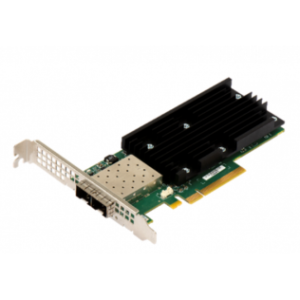
Smart network interface cards for efficient high-bandwidth GigE Vision acquisition
Matrox® GevIQ is the industry’s first network interface card (NIC) offering generic GigE Vision® acquisition offload at speeds up to 25 Gigabits/s per port. With GigE Vision packet processing performed directly onboard, Matrox GevIQ boards enable capture from one or more cameras without any image data loss.
GigE Vision is a camera interface standard that delivers rapid image transfer over distances up to 100 m using standard copper, and up to 5,000 m using standard fiber-optic Ethernet cabling. The standard supports physical links from 1 to 25 Gigabit Ethernet (GbE). Use of 10 and 25 GbE by cameras are gaining industry popularity as they are ideal for vision applications requiring the utmost imaging speed and resolution. Machine vision applications requiring cameras with a 10+ GbE interface can, however, be challenging—they benefit from a high data transmission rate but suffer from increased demands on the host system, resulting in corrupted or dropped image frames, and increased processing latency.
Matrox GevIQ NICs provide a more versatile and widely compatible alternative to custom-built or proprietary solutions based on 10+ GbE. The board is equipped with two 25 GbE ports and acquires from these with very little host CPU usage. Multiple 1, 2.5, 5, or 10 GbE cameras can be aggregated at each port for a total of up to 32 input sources. Support of the standard SFP28 connector allows users to select from standard direct attach copper (DAC) or fiber-optic Ethernet cables for their specific installation requirements.
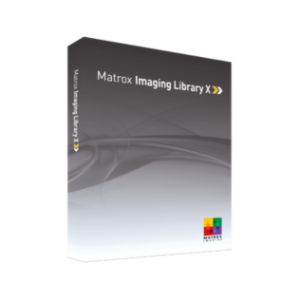
Matrox® Imaging Library (MIL) X1 is a comprehensive collection of software tools for developing machine vision, image analysis, and medical imaging applications. MIL X includes tools for every step in the process, from application feasibility to prototyping, through to development and ultimately deployment.
The software development kit (SDK) features interactive software and programming functions for image capture, processing, analysis, annotation, display, and archiving. These tools are designed to enhance productivity, thereby reducing the time and effort required to bring solutions to market.
Image capture, processing, and analysis operations have the accuracy and robustness needed to tackle the most demanding applications. These operations are also carefully optimized for speed to address the severe time constraints encountered in many applications.

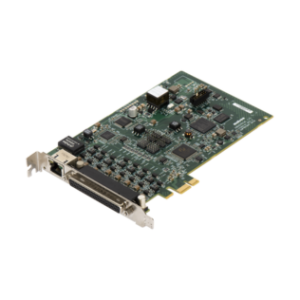
Matrox® Indio provides the industrial I/O and communication capabilities to turn any PC running Matrox Imaging vision software into a genuine vision controller. It provides discrete inputs and outputs managed in hardware for the real-time synchronization of a vision application with automation devices. It also provides Gigabit Ethernet connectivity for interfacing with programmable logic/automation controllers or GigE Vision® cameras equipped for Power-over-Ethernet (PoE).
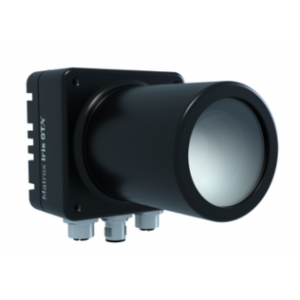
Machine vision and deep learning edge IoT device
Matrox® Iris GTX is the next evolution of smart cameras from Matrox Imaging. Offering higher resolution sensors and substantially more processing power than its immediate predecessor, Matrox Iris GTX provides exceptional performance for a compact all-in-one vision system. Paired with flowchart-based Matrox Design Assistant® X1 software, engineers and technicians can quickly configure and deploy machine vision to the Matrox Iris GTX smart cameras. Video capture, analysis, classification, location, measurement, reading, verification, communication, and I/O operations—as well as a web-based operator interface—are all set up within the same software. Matrox Iris GTX smart cameras are model edge IoT devices, performing data acquisition and analytics, and providing results nearest to the manufacturing
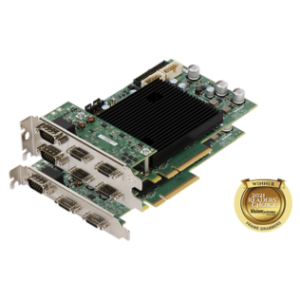
Feature-packed high-performance Camera Link frame grabber series
Matrox® Radient eV-CL is a series of Camera Link® frame grabbers with the most comprehensive features currently available in the industry. The frame grabber line-up offers reliable image acquisition, extended cable length support, and high frame-rate image capture that will extend the effectiveness of the Camera Link standard for years to come.
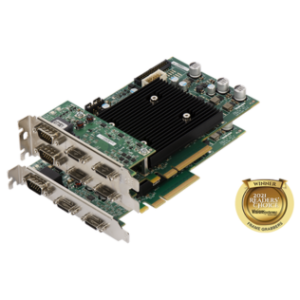
Feature-packed high-performance Camera Link frame grabbers with FPGA-based image processing offload
Matrox® Rapixo CL Pro is a series of Camera Link® frame grabbers with the most comprehensive features currently available in the industry. Built upon the field-proven design of the Matrox Radient eV series of Camera Link frame grabbers, the Matrox Rapixo CL Pro offers reliable image acquisition, extended cable length support, high frame-rate image capture, and onboard image processing offload that will extend the effectiveness of the Camera Link standard for years to come.
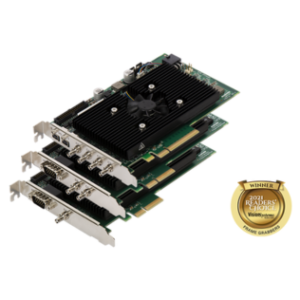
Single- to quad-input CoaXPress 2.0 frame grabbers with optional data forwarding and FPGA-based image processing offload
Matrox® Rapixo CXP is a new generation of frame grabbers, supporting version 2.0 of the CoaXPress® digital interface standard for machine vision applications. The Matrox Rapixo CXP series supports data rates of either up to 6.25 Gbps (CXP-6) or up to 12.5 Gbps (CXP-12) per connection. The PCIe® host interface comfortably matches the maximum input bandwidth from the CoaXPress links. The CoaXPress links are accessed through high-density BNC connectors allowing for a homogenous interconnection with new cameras. Power-over-CoaXPress (PoCXP) support on each connection simplifies system configurations, combining the camera’s power interface with its command- and data-interface onto the same coaxial cable.
The Matrox Rapixo CXP series of frame grabbers feature one, two, or four connections for interfacing to independent cameras. Matrox Rapixo CXP Dual and Quad models can also handle higher data rates through connection aggregation. The Matrox Rapixo CXP series possesses sufficient onboard memory to buffer incoming image data in situations where the host computer is temporarily unable to accept data. The fanless design for select models ensures extended use without maintenance.
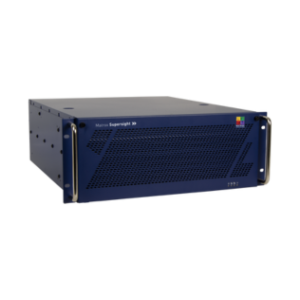
Matrox® Supersight is a high-density industrial computing platform capable of accommodating up to four computers in a standard 4U enclosure. Each computer or compute cluster is equipped with an embedded Intel® Core™ processor, and works alone or together with the others to implement distributed computing. A high-speed PCIe® switched fabric backplane ensures efficient communication and data exchange between compute clusters as necessary. The same backplane accepts full-size PCIe expansion cards for a broad range of image acquisition, network interface, processing offload, and acceleration options from Matrox Imaging and third parties. Matrox Supersight vision controllers—Matrox Supersight Solo, Matrox Supersight Duo, and Matrox Supersight Quad—are fully supported by Matrox Imaging Library (MIL) X, an established collection of software tools for developing industrial imaging applications; this software development kit (SDK) helps developers deliver a complete solution in a timely manner. Backed by a carefully managed lifecycle and consistent long-term availability, the Matrox Supersight series provides a solid foundation for demanding machine vision applications.
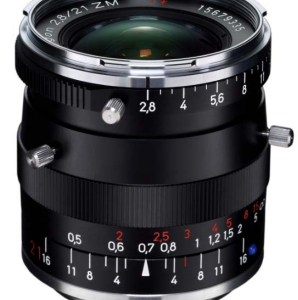
The ZEISS Classis lens family offers extraordinary image quality with high contrast for technical and industrial applications in addition to a precise fixture for focus and aperture. The outer design is characterized by a full-metal housing as well as a focus ring, which allows precise manual focusing.
Features:
• f/2.8 aperture
• Precise manual focusing
• Robust full-metal construction
• Fixation for focus and aperture
• Outstanding image quality
• Compact and lightweight
• For industrial cameras up to sensor sizes of 24×36 mm or 43mm line sensors
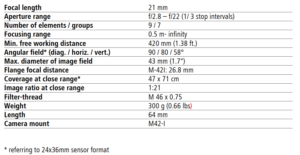
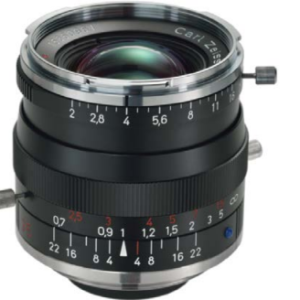
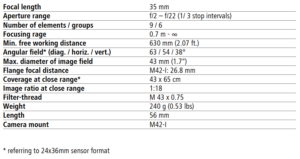
The ZEISS Classis lens family offers extraordinary image quality with high contrast for technical and industrial applications in addition to a precise fixture for focus and aperture. The outer design is characterized by a full-metal housing as well as a focus ring, which allows precise manual focusing.
Features:
• f/2 aperture
• Moderate wide-angle lens
• Precise manual focusing
• Robust full-metal construction
• Fixation for focus and aperture
• Outstanding image quality
• Compact and lightweight
• For industrial cameras up to sensor sizes of 24×36 mm or 43mm line sensors.
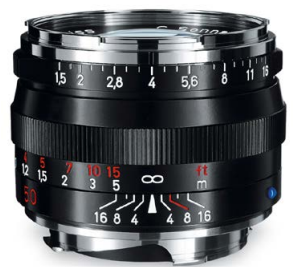
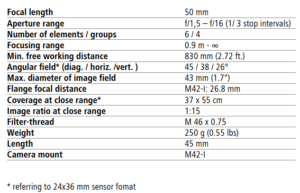
The ZEISS Classis lens family offers extraordinary image quality with high contrast for technical and industrial applications in addition to a precise fixture for focus and aperture. The outer design is characterized by a full-metal housing as well as a focus ring, which allows precise manual focusing.
Features:
• Fast 1.5 aperture
• compact standard lens
• Precise manual focusing
• Robust full-metal construction
• Fixation for focus and aperture
• Outstanding image quality
• Compact and lightweight
• For industrial cameras up to sensor sizes of 24×36 mm or 43mm line sensors.
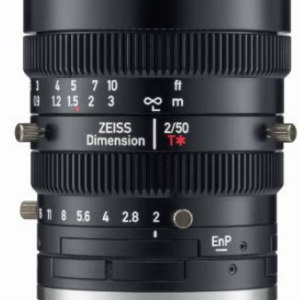
The new ZEISS Dimension® family meets the highest demands for industrial applications. The lenses developed for use with a C-mount are designed for image sensors up to a size of 4/3” and offer exceptional image quality in a compact, lightweight and rugged aluminum housing. The ZEISS Dimension® family consists of six focal lengths ranging from 8 to 50 millimeters. Almost all ZEISS Dimension lenses have the same outer diameter for reliable planning when mounting them in production facilities.
Features:
• fast f/2.8 aperture
• excellent image quality, leading to highest data precision over the complete image field
• for industrial cameras up to sensor sizes of 4/3’’
• robust full-metal construction made of aluminium
• small and compact
• possibility to adjust the back focal distance to compensate for tolerances of camera bayonets
• possibility for azimuthal adjustment ensures best possible readability of scales
• fixable focus and aperture settings
• optimized spectral transmission in VIS and near IR range through ZEISS T* coating
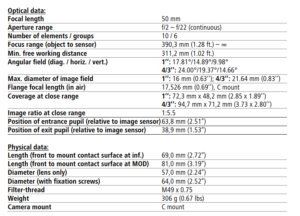
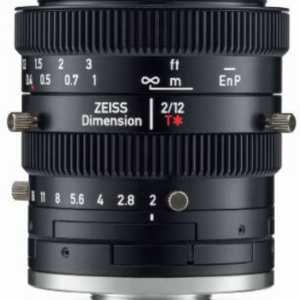
The new ZEISS Dimension® family meets the highest demands for industrial applications. The lenses developed for use with a C-mount are designed for image sensors up to a size of 4/3” and offer exceptional image quality in a compact, lightweight and rugged aluminum housing. The ZEISS Dimension® family consists of six focal lengths ranging from 8 to 50 millimeters. Almost all ZEISS Dimension lenses have the same outer diameter for reliable planning when mounting them in production facilities.
Features:
• fast f/2 aperture
• excellent image quality, leading to highest data precision over the complete image field
• for industrial cameras up to sensor sizes of 4/3’’
• robust full-metal construction made of aluminium
• small and compact
• possibility to adjust the back focal distance to compensate for tolerances of camera bayonets
• possibility for azimuthal adjustment ensures best possible readability of scales
• fixable focus and aperture settings
• optimized spectral transmission in VIS and near IR range through ZEISS T* coating
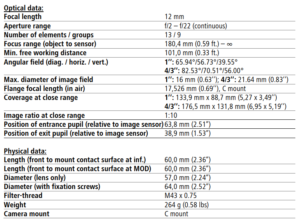
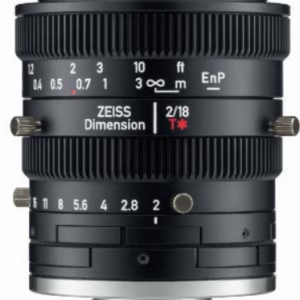
The new ZEISS Dimension® family meets the highest demands for industrial applications. The lenses developed for use with a C-mount are designed for image sensors up to a size of 4/3” and offer exceptional image quality in a compact, lightweight and rugged aluminum housing. The ZEISS Dimension® family consists of six focal lengths ranging from 8 to 50 millimeters. Almost all ZEISS Dimension lenses have the same outer diameter for reliable planning when mounting them in production facilities.
Features:
• fast f/2 aperture
• excellent image quality, leading to highest data precision over the complete image field
• for industrial cameras up to sensor sizes of 4/3’’
• robust full-metal construction made of aluminium
• small and compact
• possibility to adjust the back focal distance to compensate for tolerances of camera bayonets
• possibility for azimuthal adjustment ensures best possible readability of scales
• fixable focus and aperture settings
• optimized spectral transmission in VIS and near IR range through ZEISS T* coating
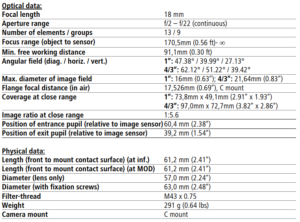
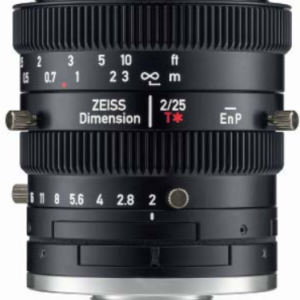
The new ZEISS Dimension® family meets the highest demands for industrial applications. The lenses developed for use with a C-mount are designed for image sensors up to a size of 4/3” and offer exceptional image quality in a compact, lightweight and rugged aluminum housing. The ZEISS Dimension® family consists of six focal lengths ranging from 8 to 50 millimeters. Almost all ZEISS Dimension lenses have the same outer diameter for reliable planning when mounting them in production facilities.
Features:
• fast f/2 aperture
• excellent image quality, leading to highest data precision over the complete image field
• for industrial cameras up to sensor sizes of 4/3’’
• robust full-metal construction made of aluminium
• small and compact
• possibility to adjust the back focal distance to compensate for tolerances of camera bayonets
• possibility for azimuthal adjustment ensures best possible readability of scales
• fixable focus and aperture settings
• optimized spectral transmission in VIS and near IR range through ZEISS T* coating
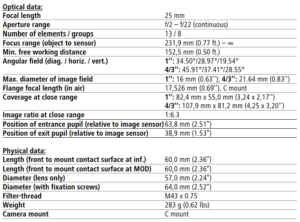
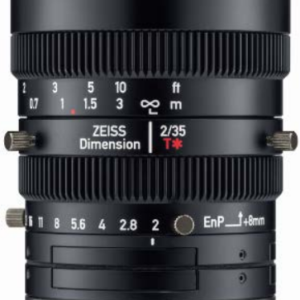
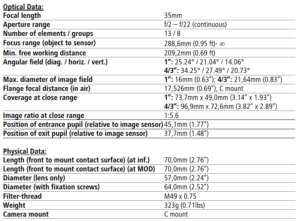
The new ZEISS Dimension® family meets the highest demands for industrial applications. The lenses developed for use with a C-mount are designed for image sensors up to a size of 4/3” and offer exceptional image quality in a compact, lightweight and rugged aluminum housing. The ZEISS Dimension® family consists of six focal lengths ranging from 8 to 50 millimeters. Almost all ZEISS Dimension lenses have the same outer diameter for reliable planning when mounting them in production facilities.
Features:
• fast f/2 aperture
• excellent image quality, leading to highest data precision over the complete image field
• for industrial cameras up to sensor sizes of 4/3’’
• robust full-metal construction made of aluminium
• small and compact
• possibility to adjust the back focal distance to compensate for tolerances of camera bayonets
• possibility for azimuthal adjustment ensures best possible readability of scales
• fixable focus and aperture settings
• optimized spectral transmission in VIS and near IR range through ZEISS T* coating
 +65 6748 5517
 info@jm-vistec.com
 10 Kaki Bukit Ave 1, #07-06, Singapore 417942