





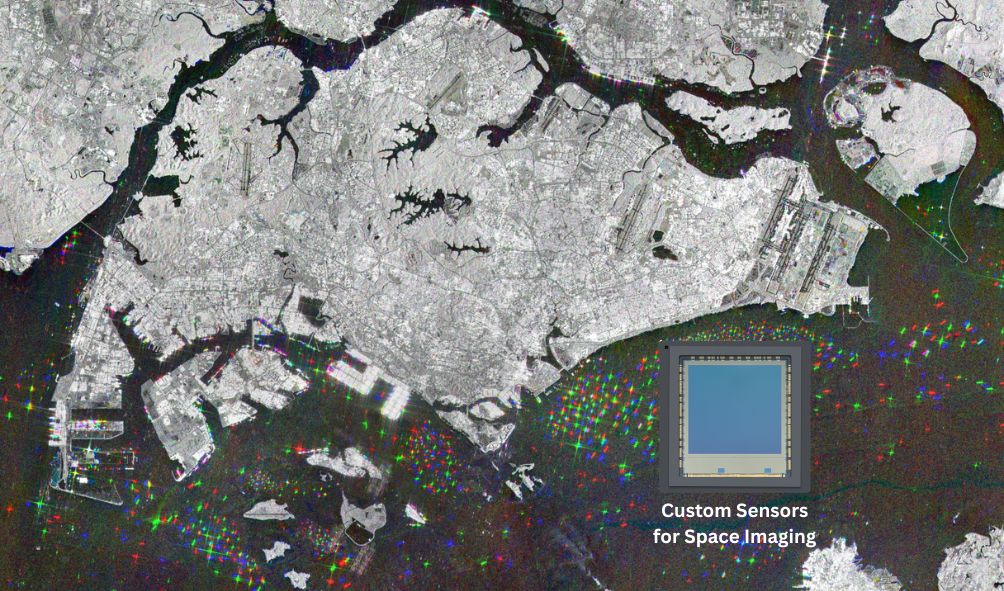
JM Vistec supplies imaging sensors specifically engineered for the space environment, from high-resolution TDI-CMOS line sensors for push-broom earth observation cameras, to radiation-hardened area array sensors for scientific instrumentation. Where no catalogue device meets your mission requirements, we design and build custom CMOS sensors around your specific payload needs.
Our team works with system integrators and satellite manufacturers to match sensor specifications to orbital parameters, optical designs, and mission lifetime requirements, whether that means selecting an existing device or developing one from the ground up.
The Challenges of Space Imaging
Space imaging presents a unique set of demands that push conventional sensor technology well beyond its limits.
- Extreme radiation exposure — Cosmic rays and trapped belt particles cause cumulative dose damage and single-event effects that degrade conventional sensors rapidly in LEO and GEO orbits.
- High ground speed and line rate — Satellites in LEO travel at approximately 7.5 km/s, requiring very high line rates and TDI imaging to capture sufficient signal without motion blur.
- Size, weight, and power constraints — Payload budgets demand highly integrated SOC designs that consolidate timing, control, clocking, and ADC on a single device.
- Multispectral requirements — Earth observation cameras must simultaneously capture panchromatic and multi-band spectral data at matched ground sampling distances from a single focal plane.
- Low-light and NIR sensitivity — Night imaging, vegetation index mapping, and spectroscopy all require enhanced quantum efficiency across visible and near-infrared wavelengths.
- Image quality over mission lifetime — Low FPN, minimal noise, high MTF, and wide dynamic range must be maintained after radiation aging and across repeated thermal cycling.
Our approach:
JM Vistec supplies imaging sensors specifically engineered for the space environment — from high-resolution TDI-CMOS line sensors for push-broom earth observation cameras, to radiation-hardened area array sensors for scientific instrumentation.
Our team works with system integrators and satellite manufacturers to match sensor specifications to orbital parameters, optical designs, and mission lifetime requirements.
Key capabilities we support:
- Radiation-hardened by design — TID tolerance to 100 Krad and SEE immunity at 75 MeV·mg/cm², validated for LEO and MEO missions.
- TDI-CMOS push-broom sensors — 12K and 6K pixel panchromatic sensors with up to 128 TDI stages and 100 KHz line rate.
- Integrated multispectral focal planes — Panchromatic and spectral band zones on a single die simplify focal plane assembly and ensure co-registration.
- Scientific area arrays — 4K × 4K BSI-CMOS sensors with 0.8e⁻ readout noise and 105 dB HDR dynamic range.
- Highly integrated SOC — On-chip timing, control, ADC, and clock driver reduce board-level complexity and power consumption.
Featured products for this solution:
- I7 — 12K Multispectrum TDI-CMOS Image Sensor. 12,288 px panchromatic zone, 128 TDI stages, 7 µm pixel, 100 KHz line rate, BSI, peak QE 85%, 100 Krad TID.
- I8 — 6K Multispectrum TDI-CMOS Image Sensor. 6,144 px panchromatic zone, 128 TDI stages, 10 µm pixel, 80 KHz line rate, BSI, peak QE 80%, 50 Krad TID.
- IRIS-4K — 4K × 4K Radiation-Hardened CMOS Image Sensor. 4,096 × 4,096 px, 8 µm pixel, 0.8e⁻ readout noise, 105 dB HDR, 20 fps, 100 Krad TID.
Typical applications:
- LEO optical earth observation (sub-metre to mid-resolution GSD)
- Multispectral and hyperspectral remote sensing
- Scientific instrumentation and star trackers
- Maritime, coastal, and agricultural monitoring
- Disaster response and change-detection constellations
Ready to discuss your space imaging requirements?
Our technical team can review your mission parameters, sensor trade-offs, and integration pathway.
 10 Kaki Bukit Ave 1, #07-06, Singapore 417942